

Unusual sounds
Hissing, popping or other unusual sounds

A practical guide to what fire blankets can do, what they cannot do, and how to prepare for an emergency
Lithium-ion battery fires are increasing sharply. By mid-August 2026, Toronto Fire Services had responded to 85 incidents, a 40 per cent increase over the same period in 2025. Toronto Fire Chief Jim Jessop called lithium-ion batteries “the fastest-evolving public fire safety risk in Canada’s largest city.”
Most of Toronto’s reported incidents involved e-bikes and other micromobility devices. However, the underlying challenge extends well beyond them. Lithium-ion batteries now power electric vehicles, forklifts, tools, energy storage systems and industrial equipment across Canadian workplaces.
When a damaged, defective or improperly handled battery enters thermal runaway, it can produce intense heat, hazardous gases, rapidly spreading fire, explosions and repeated ignition. The speed and complexity of these incidents leave little room for improvisation.
That is why more organizations are considering lithium-ion fire blankets as part of their emergency planning. A properly selected blanket may help contain visible flames, reduce radiant heat and limit fire spread, but it cannot be treated as a standalone firefighting solution.
Before adding a fire blanket to your emergency equipment, you need to understand what it can do, where its limitations lie and who, if anyone, should be authorized to deploy it.A lithium-ion fire blanket is a large, heat-resistant containment device designed to be placed over certain burning or overheating battery-powered vehicles or equipment.
Depending on the product, application and incident conditions, a fire blanket may help:
Blankets are available in different sizes and configurations for applications such as passenger vehicles, forklifts, industrial equipment and smaller battery-powered devices.
The product must be selected for the intended application and used according to the manufacturer’s instructions.
A fire blanket should not be described as extinguishing thermal runaway.
Thermal runaway occurs when rising temperatures inside a battery cell trigger a self-sustaining chemical reaction. Heat can then spread from one cell to neighbouring cells. Covering the equipment may control some external fire conditions, but it does not necessarily stop this internal process.
A fire blanket also does not:
The distinction matters. A blanket may help contain aspects of an incident, but containment is not the same as extinguishment.
Lithium-ion battery safety
 Contain flames and burning debrisReduce radiant heatLimit spread to nearby equipment or vehiclesHelp contain smoke while responders manage the incident
 Stop thermal runaway inside battery cellsRemove toxic gas or explosion hazardsReplace evacuation or emergency servicesServe as the sole control method for a large EV battery fire
The decision to deploy a fire blanket should be based on the battery type, equipment involved, incident location, stage of the fire and the organization’s emergency response plan.
Recent full-scale testing by UL Research Institutes’ Fire Safety Research Institute identified a potential explosion hazard when fire blankets were used during EV fires with active battery involvement. Its current guidance warns that using EV fire blankets indoors or in confined spaces can present a significant deflagration risk.
This does not mean fire blankets have no role. It means they should not be deployed automatically or without an incident-specific procedure developed with qualified fire-safety professionals.
A lithium-ion battery may release heat and hazardous gases before visible flames appear. Possible warning signs include:
Employees should know how to report these warning signs and when to evacuate. They should not approach, touch or move a suspected battery unless the site’s procedures specifically authorize them to do so.
Lithium-ion battery safety
A lithium-ion battery may release heat and hazardous gases
before visible flames appear.
Hissing, popping or other unusual sounds
White or grey vapour
A sharp or unusual odour
Rapidly increasing temperature
Battery swelling, bulging or deformation
Smoke, sparks or visible flames
Lithium-ion battery incidents can release a complex mixture of gases, vapours and particulates. Depending on the battery chemistry and incident conditions, these may include:
A fire blanket does not make these substances harmless. In some conditions, covering an incident may change how gases accumulate or escape.
Employees without appropriate respiratory protection should remain at a safe distance and follow evacuation procedures. Firefighters and other emergency responders working close to the incident require suitable protective equipment, including self-contained breathing apparatus.
Where appropriate, atmospheric monitoring, thermal imaging and continued observation can help trained responders assess changing conditions.
Deploying a large blanket is not as simple as throwing it over a fire. EV and equipment blankets can be heavy, require several people and place those people close to heat, smoke and potentially explosive gases.
If an organization’s emergency plan permits employees to deploy a blanket, those employees need practical training covering:
Hands-on drills should take place under controlled conditions and follow the blanket manufacturer’s instructions. Employees should never practise using an actual damaged or overheating battery.
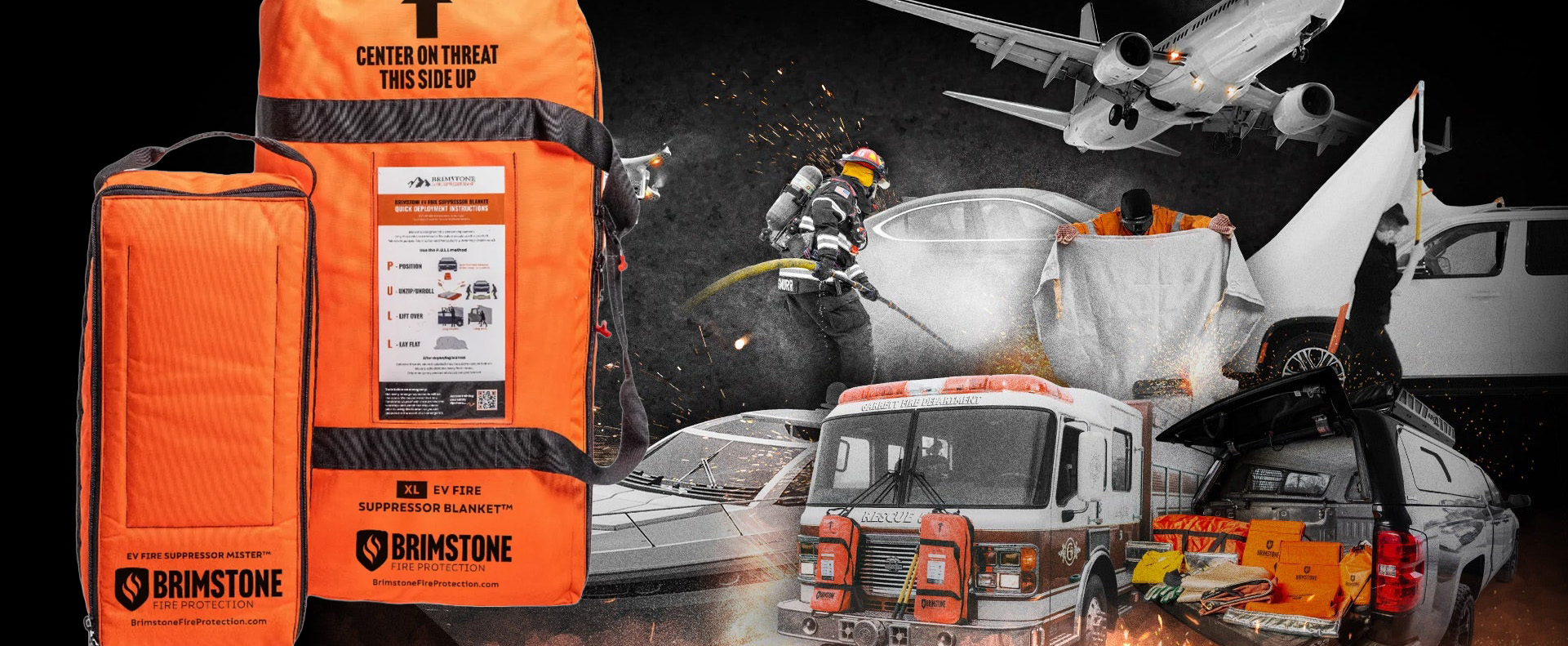
PPE requirements must reflect the size and condition of the battery, the equipment involved and the employee’s assigned emergency response role.
For limited, pre-incident handling and deployment training, PPE may include:
This equipment provides limited protection. It is not equivalent to structural firefighting PPE and does not protect an employee from every thermal, chemical, respiratory or explosion hazard.
Active EV or large-battery fires should be managed by trained emergency responders using appropriate structural firefighting PPE and self-contained breathing apparatus.
Organizations that store, charge, maintain or operate lithium-ion battery-powered equipment need a broader risk-management program.
That program may include:
Emergency planning should also address damaged batteries that have not caught fire. A dropped, crushed, flooded, overheated or visibly swollen battery may remain hazardous even when there is no smoke or flame.
As more workplaces store, charge or work around lithium-ion batteries, understanding these risks is becoming an important part of emergency planning.
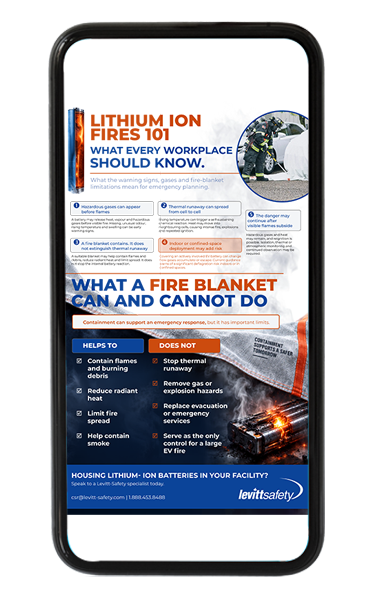
We've put together a quick infographic highlighting:
Not necessarily. A fire blanket may help contain flames and limit fire spread, but it does not necessarily stop thermal runaway occurring inside the battery.
They may help contain aspects of the incident, such as flames and radiant heat. However, they should not be viewed as a complete solution for EV battery fires.
Only if deployment is permitted by the organization's emergency response plan and employees have received appropriate training.
Requirements vary by application, but may include flame-resistant clothing, eye and face protection, heat-resistant gloves and CSA-approved safety footwear.
Follow site procedures immediately. Warning signs such as smoke, swelling, hissing sounds or unusual odours should be reported, and evacuation procedures should be followed where required.